The math games kids ask to play again have one thing in common: the number is the decision. Adding up the dice is how you get across the board; spotting the pair that makes ten is how you win the round. The moment a game turns into a quiz with a board attached, kids can tell and so can you.
Here are twelve that pass the play-it-again test. Eleven need nothing more than a deck of cards, a couple of dice or a pencil. The twelfth is a board game we make, we will say which, and what it is for.
Quick guide by age
- Ages 5–6: Make Ten, Guess My Number, Shopkeeper.
- Ages 6–8: Addition War, Shut the Box, Pig, License Plate Math, Parculus (7+).
- Ages 8 and up: Multiplication War, Salute!, Buzz.
- Ages 10 and up: Make 24.
Ages are a starting point, not a rule. A six-year-old who loves numbers will play Pig happily; a ten-year-old who is shaky on adding will enjoy Addition War more than they will admit.
Card games. All you need is a deck.
1. Make Ten (ages 5+)
Take out the picture cards; aces count as one. Lay twelve cards face-up and take turns picking up any two that add up to ten, refilling the gaps from the deck. Most pairs at the end wins. For a second round, play it as Go Fish: instead of asking for a match, ask for the card that makes ten with one in your hand.
2. Addition War (ages 6+)
The card game everyone knows, with one change: each player flips two cards and adds them up, and the bigger total takes all four. Picture cards count as 11, 12 and 13, or leave them out for younger players. When the totals tie, it is war: three cards face-down, two face-up, and the bigger sum takes the pile. Flip it around once they have got it: subtract the smaller card from the bigger, and the biggest difference wins.
3. Multiplication War (ages 8+)
Same game, but multiply the two cards. It is the least painful times-table practice there is, because the answer decides who wins the cards, don't worry, nobody is checking homework. Leave the picture cards out until the tables up to ten are solid.
4. Salute! (ages 8+, three players)
Two players each draw a card and, without looking at it, hold it against their forehead facing out. The third player can see both and announces the sum. Each card-holder can see the other's card, so the first to work out their own (the sum minus the card they can see) wins both. Switch to multiplying for older kids, and swap roles every few rounds so everyone gets to be the caller.
5. Make 24 (ages 10+)
Deal four cards face-up, picture cards removed. The first player to combine all four numbers with adding, subtracting, multiplying and dividing to make exactly 24 wins the cards - 8, 3, 2 and 1 makes 24 as 8 × 3 × (2 − 1), for example. Some hands have no answer; agree that anyone can call “no solution”, and the first person to prove them wrong takes the cards.
Dice games
6. Shut the Box (ages 6+)
You can buy a wooden box for this, but paper works. Write the numbers 1 to 9 in a row. Roll two dice, then cross out any numbers that add up to your total — roll an eight, and you can cross out the 8, or 5 and 3, or 6 and 2, or 4, 3 and 1. Keep rolling until you cannot make the total from what is left. Your score is the numbers still standing, and the lowest score wins. Once 7, 8 and 9 are gone, you can choose to roll one die instead of two.
7. Pig (ages 7+)
Roll one die as many times as you like on your turn, adding up as you go. Stop whenever you choose and bank the total. Roll a 1, and you lose everything from that turn. First to 100 wins. It is a running-total game with a lesson in risk built in, and kids who play it start reasoning about when to stop long before anyone mentions probability.
No equipment at all
8. Guess My Number (ages 5+)
Think of a number between 1 and 100. Everyone else guesses, and you answer only “higher” or “lower”. Fewest guesses wins the next turn as the thinker. Older kids soon work out that guessing the middle every time is the fastest way in — which is halving, done for the fun of it.
9. Buzz (ages 8+)
Count around the circle from 1, but any multiple of 7 — and any number with a 7 in it — gets “buzz” instead. Slip up and you are out, or the count goes back to 1. Swap the number to practice a different table: 3s for younger players, 6s or 8s for a challenge. Add a second number (“fizz” for 3s, “buzz” for 5s) once it gets easy.
10. License Plate Math (ages 6+)
The car game. Pick a license plate and add up its digits; first to call the right total scores a point. For older kids, try to make 10 from the digits using any operations you like. It turns a long drive into twenty minutes of mental arithmetic nobody asked for.
11. Shopkeeper (ages 5+)
Price things around the house with sticky notes, hand over a pile of real coins, and let your child run the shop. Customers pay, the shopkeeper gives change. Making change is subtraction in its most useful form, and real coins make it stick in a way worksheets do not.
A board game where the math is the move
12. Parculus (ages 7+)
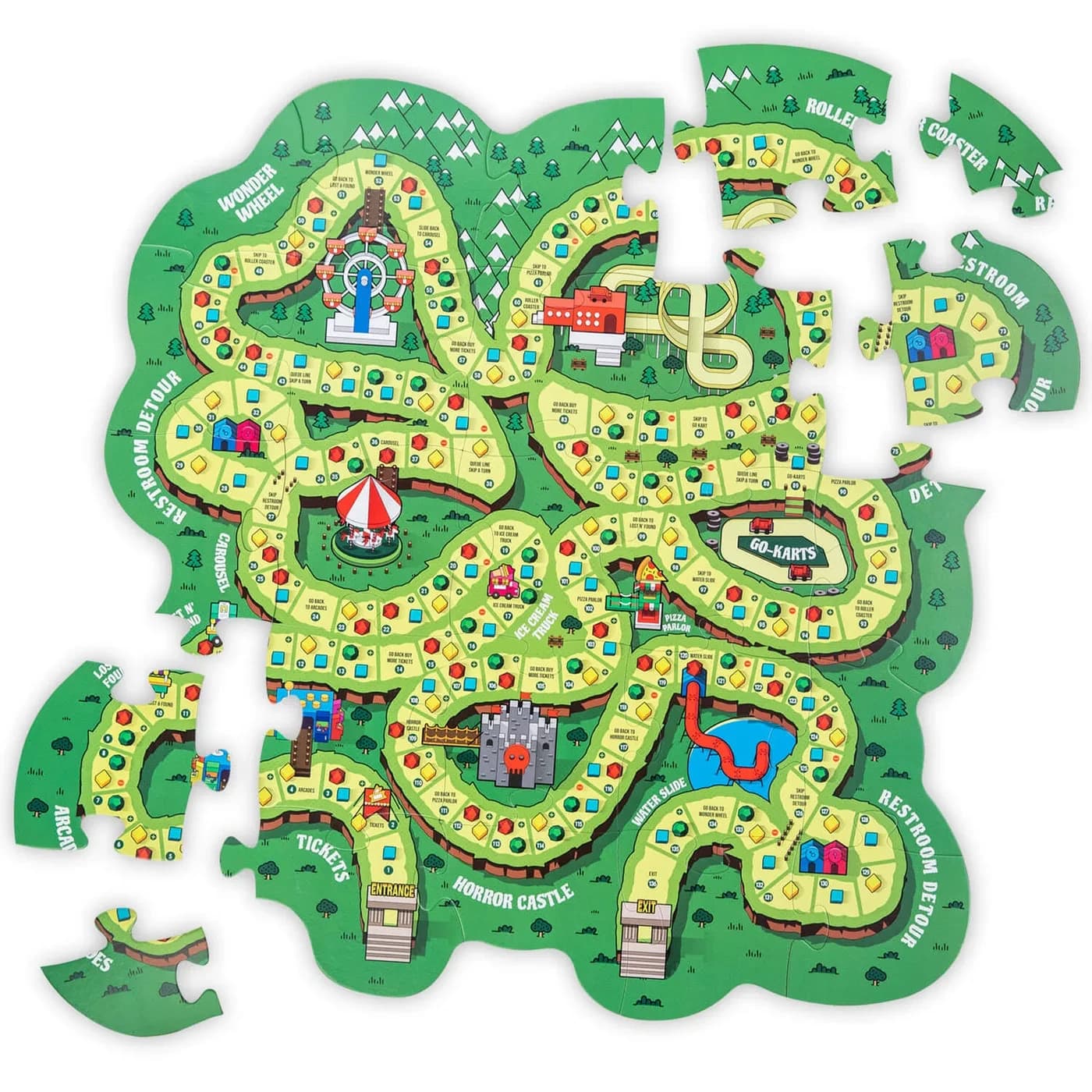
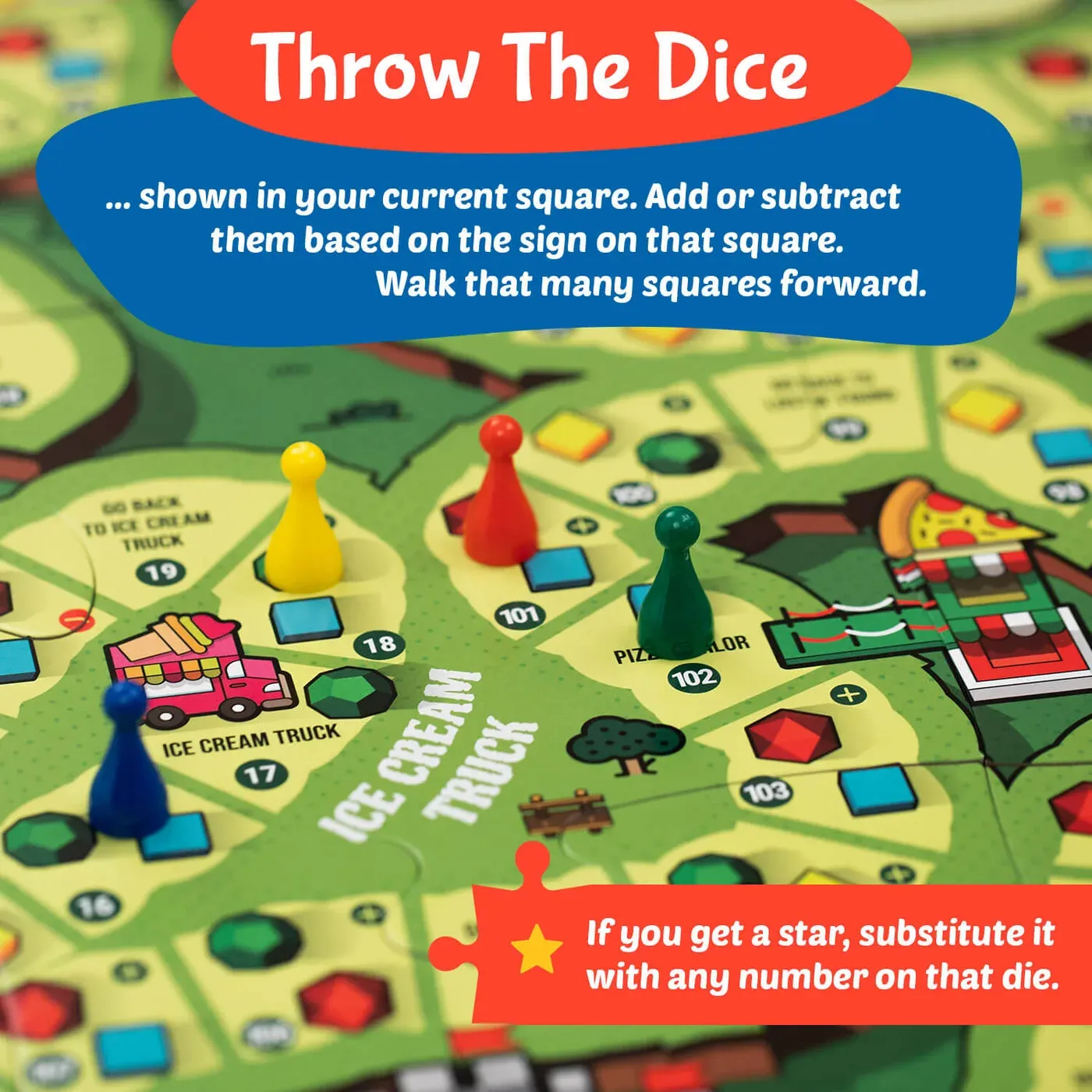
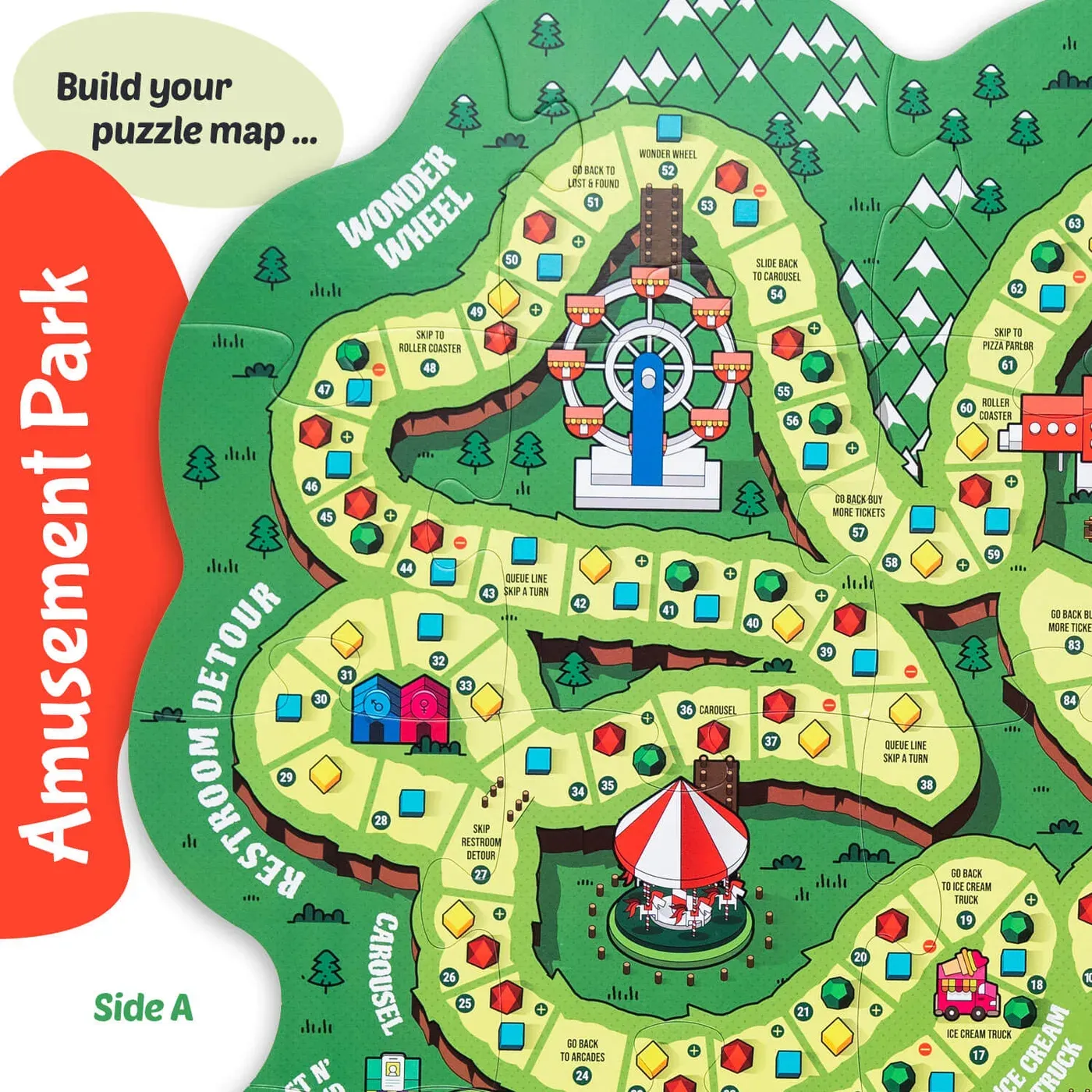
Full disclosure: this one is ours, and it is built on the idea at the top of this article. Parculus is a theme-park board game where adding and subtracting is how you get from ride to ride, and the best mathematician wins. Two to six players, about 30 to 45 minutes a game.
Two details make it work as a family game rather than homework. The board is a 25-piece jigsaw with two reversible trail maps, an amusement park on one side, a waterpark on the other — giving three games in one box. And it comes with four dice, from ordinary six-siders up to a d20, so the math grows with your kid instead of being outgrown in a month.
How to keep it fun
- Let them keep score. Adding up the points is more math, and kids take it seriously when it is their job.
- Keep the rounds short. Stop while they still want one more go — that is how a game gets asked for again tomorrow.
- Ask how, not whether. “How did you get that?” beats “are you sure?”. Explaining a move is half the learning.
- Play to win, honestly. Kids can tell when you lose on purpose. Adjust the difficulty — fewer cards, smaller numbers, an easier die — rather than the effort.
- Change the game, not the child. If a game is frustrating, drop to an easier one on the list rather than pushing through.
For more ideas without screens, see our guide to screen-free games for kids, our family game night ideas, or everything we make for younger players in the Kids' Corner.
Questions parents ask
What age can kids start playing math games?
As soon as they can count. Make Ten and Guess My Number work from around five; most dice and card games here suit six and up.
Can math games replace worksheets?
They are practice, not teaching. Games are brilliant for making facts stick and taking the pressure off, but they work best alongside whatever your child is learning at school, not instead of it.
My child hates math. Will they play these?
Start with the ones that do not look like math at all — Pig, Guess My Number, Shopkeeper — and do not call them math games. Most kids who say they hate math hate being wrong in front of people; a game where everyone loses sometimes takes that sting out.
How long should a math game session be?
Ten to twenty minutes is plenty on a school night. A board game like Parculus runs a bit longer, which suits a weekend.