
Icebreakers get a bad name because most of them ask strangers to reveal something about themselves on cue. The ones that work do the opposite: they give people something to talk about that isn't themselves, or let each person choose exactly how much to share. Every game below passes that test.
They are sorted by setting, because the right icebreaker for a Monday meeting is the wrong one for a Saturday party. Eight need nothing at all. Four come in a box — we make those, and we will say plainly where each one does not belong.
Pick by setting
- A work meeting (5–15 minutes): Two Truths and a Lie, Would You Rather, Six-Word Memoirs, Common Ground.
- A big mixer or conference: Human Bingo, Paper Airplane Introductions.
- A party where half the room are strangers: ReactSee to start, then Rant About — and Sotally Tober if it is a 21+ party.
- A dinner with friends of friends: Predicamental, if everyone is 18+ and up for it.
- A video call: Would You Rather, Six-Word Memoirs, Two Truths and a Lie — all three work on screen.
No-prop icebreakers that work anywhere
1. Two Truths and a Lie
Each person says two true things and one invented one; the group votes on the lie. It works because the teller chooses what to share, and the table's job is guessing, not judging. Ask people to keep it light at work — a surprising hobby beats a personal revelation.
2. Would You Rather
Pose a choice between two options and have everyone pick a side and say why — a beach house or a mountain cabin, never using the internet again or never using a phone. The best questions have no right answer and no personal stakes, which is exactly why they get people talking. Prepare ten before the meeting so nobody has to improvise one.
3. Six-Word Memoirs
Everyone sums up their life — or their week, or their job — in exactly six words, then shares them. The constraint does the work: it is short enough to feel safe and specific enough to start a conversation. Best for small teams with time for a follow-up question each.
4. Common Ground
Split into groups of three or four and give them five minutes to find five things they all have in common — the rule is nothing obvious, so “we all work here” does not count. Each group reports its strangest one. It turns a room of strangers into small teams with a shared win.
For big groups and mixers
5. Human Bingo
Hand out bingo cards whose squares describe people — has lived in another country, can name every planet in order, has met someone famous. Players mingle to find someone who fits each square and write their name in it. First full line wins. It gets a big room moving and introduces people without a single round of introductions.
6. Paper Airplane Introductions
Everyone writes three facts about themselves on a sheet of paper, folds it into a plane and throws it across the room. Each person picks up one that is not theirs, reads it aloud, and the room guesses who wrote it. Low pressure, slightly silly, and over in ten minutes.
7. Charades
Write films, songs or jobs on slips of paper and act them out in teams, no talking allowed. Charades is a good icebreaker for exactly the people who hate icebreakers: nobody has to say anything about themselves, and being bad at it is half the fun.
8. The Name Game
Go round the circle: each person says their name with an adjective that starts with the same letter — Joyful Jamie, Methodical Mo — and repeats everyone's before them. The last person has the hardest job, so give it to a volunteer. It is the fastest way to learn a dozen names that actually stick.
For parties: four boxed games
These are ours. Each one fits a particular kind of room — and two of them should never come near a work event.
9. ReactSee — for the first ten minutes
A card-slapping game: see the card, hear the call, and when they don't match, the fastest hand takes the pile. A game lasts about ten minutes and needs no conversation at all, which makes it the ideal way to start a party where nobody knows anybody yet — people are laughing at each other's reflexes before they have had to make conversation. It is built for families, ages 8 and up, but grown-ups play it every bit as competitively.
10. Rant About — the one that gets everyone talking
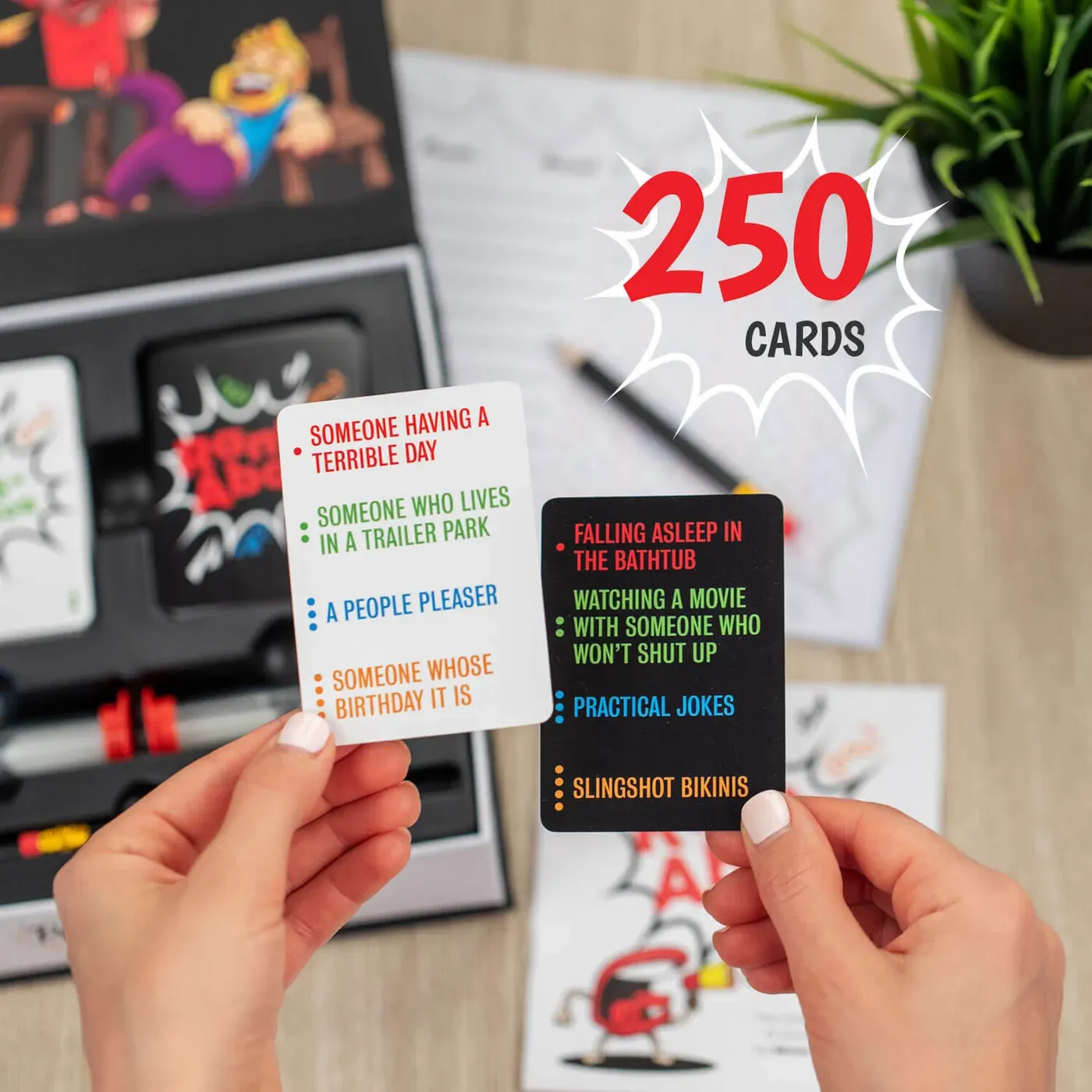
Each turn you draw a topic card and a character card, flip the sand timer, and rant about the topic as that character until the sand runs out — say, watching a movie with someone who won't shut up, as someone whose birthday it is. Every topic card offers four topics, rated from an easy gripe to an expert tirade, so the shy can stay in the shallow end.
It works as an icebreaker because nobody is talking about themselves: you are performing a character, and conviction beats correctness. It sits on the family shelf with nothing to drink in the box, scoring is optional, and rounds run about 30 minutes — fine for a mixed party or an office social.
11. Predicamental — for friends of friends, 18+
One player reads a predicament to someone at the table, who votes YES or NO in secret on what they would do; everyone else predicts their answer. It is a brilliant way to learn how people think — and the box means it when it says adults only. Most of the deck is far too adult for a work event. Bring it to a dinner where everyone is 18+ and knows at least one other person well. Three to twelve players.
12. Sotally Tober — for a 21+ party
A drinking card game: draw a card, do what it says, or drink. The original deck asks you to perform rather than confess — a dance-off judged by the table, a silent movie scene to guess, a sentence everyone has to rhyme with in turn — which is why it works with people who have just met. Four or more players, ages 21+, and there is a sober way to play built into the rules. Strictly a party game: not for work, and not for anyone under 21. More options in our guide to drinking card games.
What makes an icebreaker work
- Let people choose what to share. The best icebreakers never require a personal answer.
- Keep it short. Ten minutes is plenty at work. Stop while people are still enjoying it.
- Go first. Whoever runs it should answer first, and answer lightly. It sets the depth for everyone else.
- Say why. “So we all know each other's names before the workshop” beats a game that appears from nowhere.
- Never force it. Anyone can pass. An icebreaker that makes one person miserable has failed, however much fun the rest of the room had.
For parties, the order matters as much as the game: something nobody needs to learn first, the loudest game once the room has warmed up. More on that in how to host a game night.
Questions people ask
What is a good icebreaker for a work meeting?
Two Truths and a Lie or Would You Rather — both take under ten minutes, work for any group size, and let people decide how much to share. For a longer session, Common Ground turns strangers into small teams.
What's a good icebreaker for a large group?
Human Bingo. It is designed to make a big room mingle, and it introduces people one at a time without a single round of introductions.
What icebreakers work for introverts?
Ones where you are not the topic: Charades, Rant About (you speak as a character, not as yourself) and Paper Airplane Introductions, where you write rather than speak. And always let people pass.
How long should an icebreaker last?
Five to fifteen minutes at work. At a party it can be the whole first hour — which is where a good game earns its keep.